
Billboard's Chart Shake-Up: New Streaming Rules Spark Industry Tension as YouTube Exits Partnership

In a major shift reflecting streaming's dominance in U.S. music revenue, Billboard has updated its chart methodology, giving greater weight to streaming and narrowing the gap between paid and ad-supported streams.
The move, effective with charts dated January 17, has been met with mixed reactions and a significant development: YouTube will stop submitting its data to Billboard's charts in 2026 over a dispute regarding the new formula.
Previously, an album unit was equivalent to 1,250 paid streams or 3,750 ad-supported streams. Under the new rules for the Billboard 200 and Hot 100 charts:
One album unit now requires only 1,000 paid/subscription streams (a 20% reduction). One album unit now requires only 2,500 ad-supported streams (a 33.3% reduction). This adjustment shifts the ratio between paid and ad-supported streams from approximately 1:3 to a narrower 1:2.5, meaning it takes fewer streams overall to achieve an album unit. Billboard implemented this change to better align the charts with actual streaming revenue data and evolving music consumption behaviors.
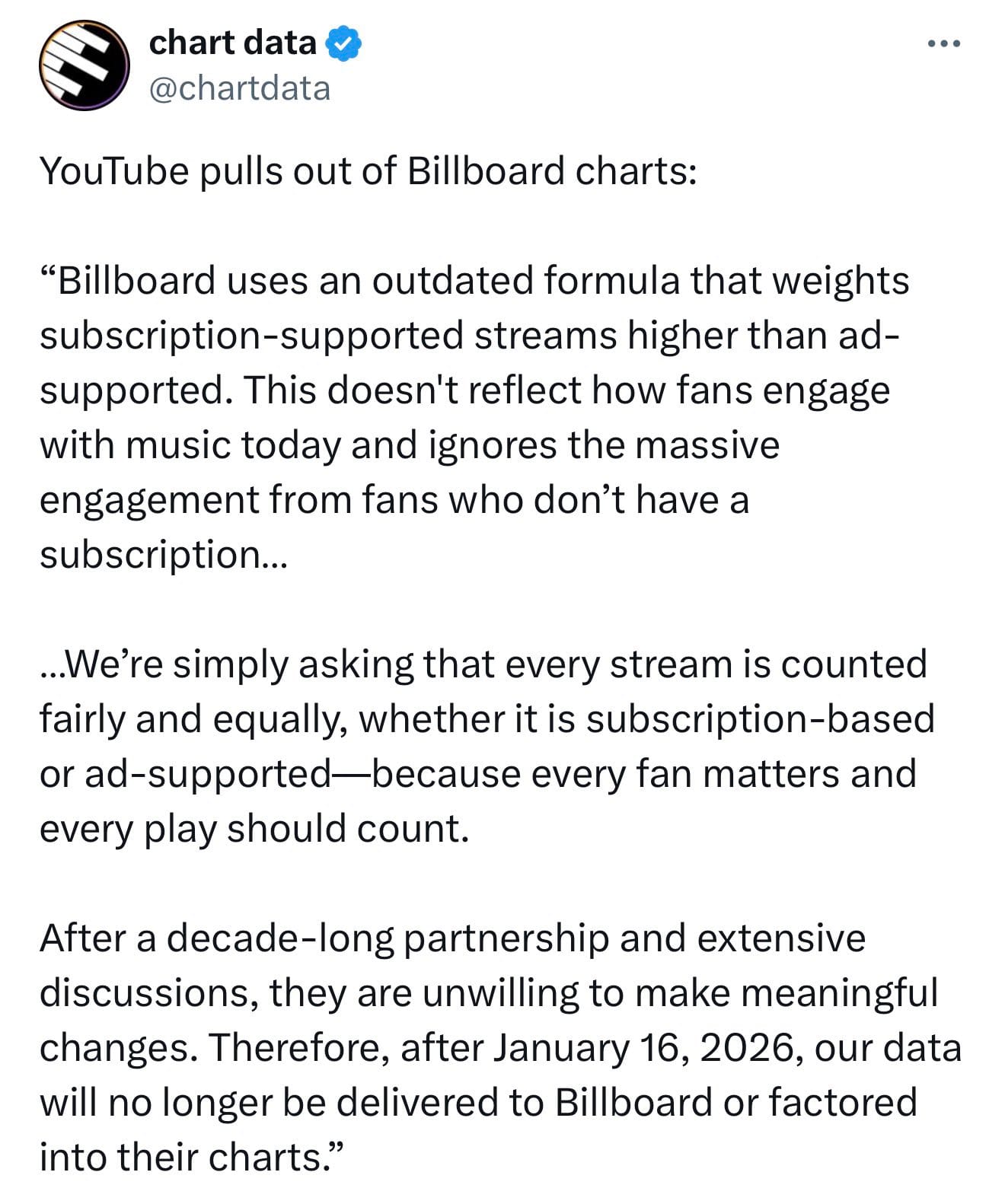
YouTube's Formal Withdrawal Hours after Billboard's announcement, YouTube's Global Head of Music, Lyor Cohen, announced that the platform would end its decade-long partnership with Billboard after January 16, 2026. The core of the dispute is YouTube's argument that all streams, whether paid or ad-supported, should be counted equally.
Cohen criticized Billboard's formula as "outdated" and stated that it undervalues the massive fan engagement on YouTube. By withdrawing its data, YouTube hopes to pressure Billboard into recognizing the platform's cultural and economic impact with a more equitable representation in the charts.
The changes are expected to benefit artists whose music generates significant engagement on ad-supported platforms like YouTube, particularly those in the hip-hop and pop genres who excel at creating viral visual content. The move highlights ongoing tensions within the music industry regarding how value is assigned to different types of music consumption.
While some see the update as a necessary adaptation to the modern streaming landscape, others, like Spotify's head of music, argue that a paid stream represents a higher level of fan intent and should hold more weight.
Read also: